
Notifications
Clear all
Topic starter
13/12/2017 03:35:09
Bunge spring piston airgun
These guns have been attributed to Charles Bunge of Geneva, New York, who made a revolving percussion rifle and was associated with a number of inventions, including, in 1890, a folding peep sight.
Scientific American magazine said this in 1869:
Revolving Spring Gun.— Charles Bunge, Geneva, N.Y.— This invention
relates to a new spring air-gun, which is so constructed that it can be
readily set to automatically place a charge into the barrel, or at least in
line with the same; it being provided with a reservoir which contains a
suitable large number of charges. The invention consists chiefly in the
combination of a perforated revolving feed plate with a stationary supply
or reservoir chamber, from which, as the feed plate is turned, the balls
constituting the charges, are transferred into the apertures of the feed
plate.
With thanks to Sean Campbell, imaging manager of the Buffalo Bill Centre of the West in Cody, Wyoming, for permission to post these pics of guns held in the Cody Firearms Museum. The blurb accompanying these guns follow the pics.


Accession Number: 1993.8.14
Date : 1870-1879
Dimensions: L: 39.5 in, Barrel length: 18.25 in, H: 7 in
Credit Line: Gift of Thomas K. Hutchinson
Remarks: unknown maker, possibly Charles Bunge (sp?), Geneva, NY
Inscription: [receiver, right side below barrel] 1777; [lock plate top] Frank. James.; [bottom cylinder] 1777
Synopsis: firearm- airgun- Unknown- wood- brass- steel- [receiver, right side below barrel] 1777; [lock plate top] Frank. James.; [bottom cylinder] 1777- .30- 1777- unknown maker, possibly Charles Bunge (sp?), Geneva, NY


Accession Number: 1993.8.13
Date : 1870-1880
Dimensions: L: 45 in, Barrel length: 20 in, H: 6.5 in
Credit Line: Gift of Thomas K. Hutchinson
Remarks: spring piston revolver
Synopsis: firearm- airgun- Unknown- wood- brass- steel- Bunge (?) type- .28- spring piston revolver

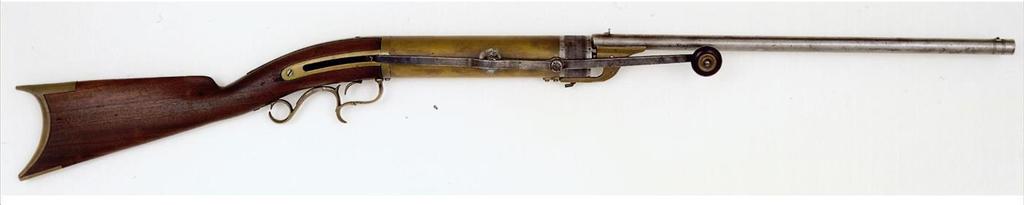

Accession Number: 1993.8.12
Date : 1870-1880
Dimensions: L: 48 in, Barrel length: 19.875 in, H: 7 in
Credit Line: Gift of Thomas K. Hutchinson
Remarks: spring piston revolver; made in upstate New York
Inscription: none
Synopsis: firearm- airgun- Unknown- wood- brass- steel- none- Runge (?) type- spring piston revolver; made in upstate New York
A similar spring-powered gun was also shown on the Airgun Rendezvous web site, posted by Kurt Wag, which he said was "made in mid 1800's in USA by a Canadian. It's a 13-shot revolver with a lever assisted cocking mechanism":


Topic starter
15/07/2022 17:46:55
Bunge, Charles revolving spring airgun patent
With thanks to Bruce Jr.


Topic starter
15/07/2022 18:17:52
Bunge airgun
With thanks to Mark.


Topic starter
27/07/2022 18:24:02
Bunge spring piston airgun (fabricating a new sear)
With thanks to Mark and Larry H.
Mark posted this pic of his Bunge with the sear missing:

Larry H dismantled his Bunge and discovered the trigger layout was slightly different:


Mark posted this:


He added:
I have an update to share. I received a piece of steel from Wes and used it to fabricate a replacement. Got it right after I broke the first attempt. I then had to do some further tweaking on the sear and coil trigger spring to get it to return properly, now that I had a real trigger lock spring in place. It seemed to work in practice, IE: not under load of the firing springs.
Next step to see if I could assemble it with the firing springs in place. Larry warned me this is challenging to assemble. His method involved leaning into a bench to help compress the spring and thread on the plunger. This is very tricky to accomplish, considering the age of the item we are working with.
I came up with a way to use my vise as a solid base to hold the brass body of the firing mechanism. This worked after a few attempts. I had successfully threaded the plunger on!... however, I soon realized that I cannot put in the screw that goes into the handle at the bottom of said brass body.Disassembly number 1 went without incident...
I must assemble it with the stock attached. I wanted to avoid this as this is some darn old wood, that has been epoxied already once. But there is no way around it. So I used Larry's 'lean into a bench method' as I could devise no better to achieve the leverage required to compress this spring. And I tried a few. Assembly number 2 went successfully... until I realized that I have to put all the trigger components into the brass body before it goes into the stock. Clearly I was not having a good day.
Disassembly number 2 went without incident.At this point I have quite a rig set up to ensure I can safely compress the spring, whilst preventing the contact point on the bench from slipping, while turning the plunger on a socket that prevents damage to the leather, attached to a bearing that allows me to turn the plunger without marring it. All while leaning into it with all my strength and body weight to compress the spring and magically / blindly aligning the threaded rod to the threaded plunger and praying that I get it started without stripping the threads.
Assembly number 3 was not successful. I simply lacked the necessary strength to get this contraption to work and thread the plunger on successfully. As it turns out I need to treat the sear anyway so I have a few days to recover my strength and try this again.
I can imagine a few jigs I that could have been used in the shop to compress these springs and make this easier but I do not have the tools to create them. I will let you know here when I have completed this assembly.
Again, thank you all for your help and support. Some pictures below to entertain you. I am sure some of this sounds familiar to your first attempts at gun restoration.


Mark added an update:
After some pondering and experimentation with the mechanism, I determined that the leaf spring I had made was not pressing the lock up far enough. I could have adjusted it and re-tempered it, but I decided to create a new spring that was wider and fit better. This first one was difficult to keep in position.
I discovered McMaster-Carr's website and ordered spring steel 1095 that was only annealed. This came in 1 day (O.O). I created the below successfully and the new spring worked wonderfully.However, the stock did not survive the cocking of the mechanism. Now I have a new problem. I think that replacing the stock is out of the question. It is, after all, around 150 years old. I do not wish to be hunted down by purists for vintage air gun blasphemy and truthfully my woodworking skills are only so so. I have resolved that I must take apart these old repairs, clean the old glue out and redo them.

- The gun crumbled. It survived the previous 30 ish attempts. Murphy's law I guess...
Taking apart this stock has revealed many repairs. I think hide glue was used at one time. Something very hard and in Amber color was used to glue and fill in areas on the stock. It was impervious to Stripper, but yielded under the pressure of a pick. The edges of each of the splits were filled in with this 'glue'. There are 1/32-1/16" gaps virtually everywhere. It should be interesting to get this back together. The Dark Wood Glue comes tomorrow... One step at a time.

- Note the mechanism functioning as designed!


