
Notifications
Clear all
Topic starter
19/12/2017 21:59:18
Topic starter
19/12/2017 21:59:53
Diana MGR pistol.
With thanks to Steve for these pics:


With thanks to Mick Shepherd from micksguns.com for permission to post these pics of a nickelled MGR:


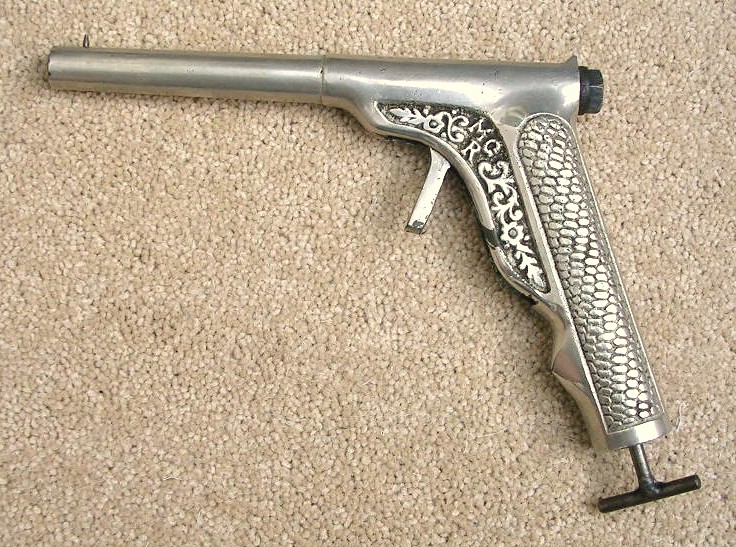
Thanks to Richard L for this pic.

Topic starter
19/12/2017 22:00:39
Diana MGR Tahiti (Gamages, blacked)
With thanks to John G for this pic.

Topic starter
15/02/2019 15:43:56
Diana MGR pistol
With thanks to Steve for pics of this pistol that he inherited from his grandfather. The cocking aids are reproductions.


Topic starter
24/05/2019 14:23:23
Diana MGR pistol (Nickel, Gamages box)


Topic starter
25/11/2019 17:17:37
Diana MGR with reproduction cocking tools
Pics copyright Holts auctioneers.


Topic starter
08/12/2020 17:26:02
Diana MGR (sharp casting)
Posted on the airgunforum.co.uk.
Note: this pistol has an unusually sharp embossed floral casting.
I asked spring air pistols expert Professor John Griffiths whether this might be to do with a new (ie not worn) mould and he said:
I suppose one argument would be that the mould used to make the castings could have got progressively worn, as happens with bronze castings. However, unlike most metals, iron and steel casting has to be done with sand moulds, as the melting temperature is so high, and the pattern is impressed in the sand. After casting, the mould is destroyed, so a new one is used each time. I suppose the master could wear out, but it would take a long time. Casting iron and steel is almost a black art, and even the nature of the sand can affect the result, so it is quite possible that sometimes the parameters are just perfect for a fine impression, and other times not.


Compare it with this one, for instance:
Matt supplies more pics of this pistol:


Topic starter
19/04/2023 20:24:57
Diana MGR (cased)
Note: the case is new-looking.


Topic starter
28/02/2025 17:03:01
Thoughts on casting the Diana MGR
An interesting thread on this ran on the airgunbbs.com.
Contributions included from Matt (Ptdunk), Matt G, John G and casting expert 'trajectory':
Was it a lost wax sand mould? Any idea how the barrel & cylinder voids were done?
We can get a clue about how pre-1900 cast iron pistols were made from the wording of the 1902 patent by Jacob Mayer relating to this pistol. (British patent 20,560). In it he suggests that the norm with pistols of this type was to cast them with a solid barrel and cylinder, and then drill these out. This was obviously expensive and could lead to structural weakness. His patent then describes a labour-saving approach ,where the barrel and cylinder are cast hollow, and then steel tube inserts are used to cover over the inevitable imperfections, holes etc. that this would produce. Unfortunately he does not say how the hollow casting would be achieved.
His pistol had been in production for some years before the patent, so there should be surviving examples made by the older boring-out method.
How about a solid pattern in two halves with locating pins & two sand casting boxes. Then once the boxes are split then a "solid" sand core it placed in it for barrel & cylinder, the mold box closed & then it can be cast.
In principle it is a pretty simple technique in foundry practice. Once the pattern is made it's pretty straightforward to do using a special sand blended with binders etc to embed the pattern in. You cut a vent hole/holes & pouring hole , do a few more odds & ends fix the core in place clamp up the boxes & pour in the molten metal. Once cooled the casting is cleaned up of sprue , flashing etc & the holes left by the core are cleaned out & then it's on to the next stage of manufacture, boring to a finish or tube lining?
I can’t comment on the MGR, but the Morse air pistol which has a very similar design as had a sand core used to cast the grip hollow.
What I don't understand is what the core "sand" is composed of. It has to be completely rigid so that it can be suspended in the mold with a void all around it for the molten steel, and it has to be able to keep its rigidity at temperatures above 1600oC. It can't be metal as that would fuse to the casting. Any ideas?
Although casting components is fairly straightforward the complexity increases when you introduce cores into the process.To some degree the casting sand for the main structure or item being cast is fairly tolerant but as you suggest the core needs to withstand the ardour of the casting proces such as the flow of molten metal yet be relatively easy to remove from the casting. To this end sand types, binders, mixers, grain size, moisture content, porosity, heat capacity, dimensional stability (& a few other factors) all influence the properties of a core. So with varying the content it is possible to "tune" a formulation to a process. Cores can be produced by compression/ baking to produce a suitable product. Cores need not just be made of sand, plaster & or derivatives can be used too.
Then the core is positioned into one half of the void left by one half of the pattern in the sand box & the other sand box with the other half of the pattern is carefully put onto the first sand box. All clamped up & ready for casting.
Once cast, & cooled the boxes are opened & the casting recovered & the core material cleared from the void.
Maybe the above helps visualise the process, there are quite a few more steps in the casting process but hopefully the foregoing might be of interest & also be of some use.
Fascinating. The complexity and skill obviously needed makes me wonder how on earth they produced such huge number of these pistols that were only ever going to be sold at the cheap end of the market. Wages must have been incredibly low!
With casting one of the things you can do is produce gang moulds so instead of making a mould to produce one item you can make one that produces multiple castings. This usually requires multiple patterns. The numbers produced with gang moulds might depend on size, weight, crucible capacity & other technological considerations as well as commercial ones ie. demand etc. it is still labour intensive but there again there is economy in numbers & it can reduce the cost per item. It's another layer of complexity to the casting process but it's problems are not insurmountable & if the benefits outweigh the difficulty then it's a way to get the costs down & production up.
